Meta AI
- 4.6
- Rating
- 50.00M
- Installs
- Free
- Price

 Analysis by App-foxy
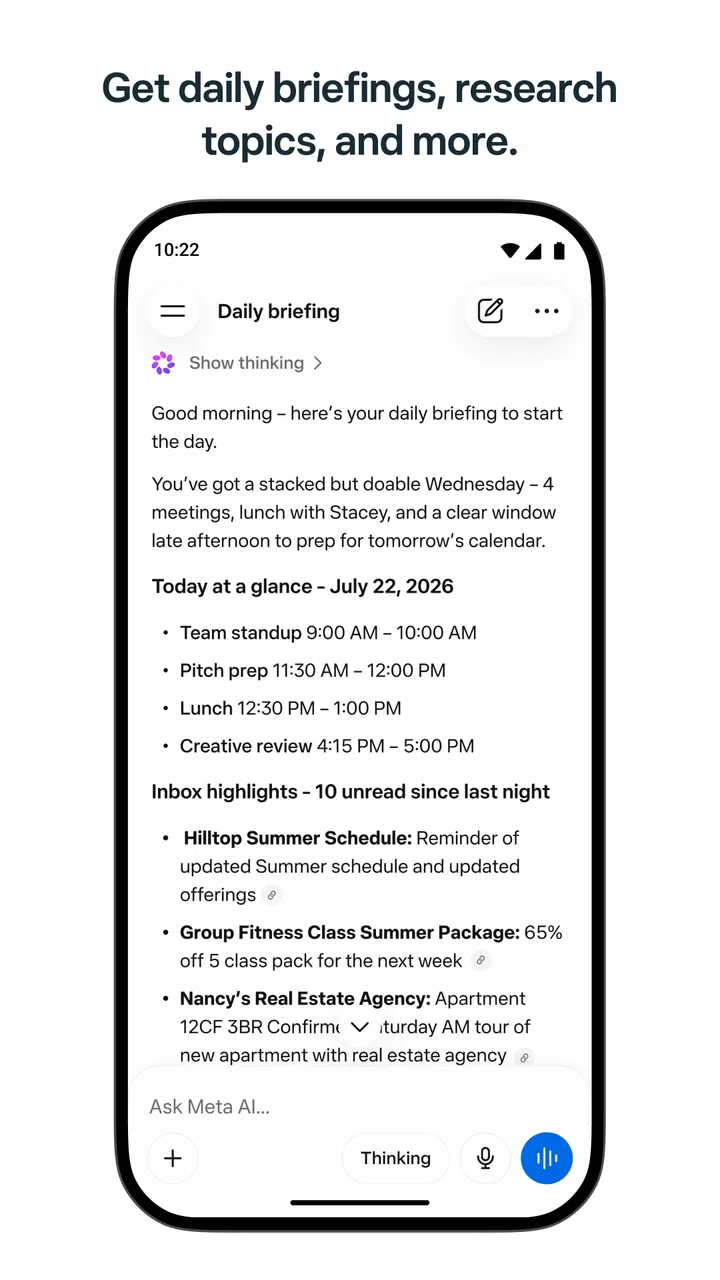
Meta AI is the kind of productivity app I would suggest when you want quick help without opening a full desktop tool. Its focus is simple on the surface: ask for answers and create AI videos from a mobile device. In practice, the value depends on how clearly you describe what you want and how comfortable you are checking the result before using it. I found it most useful as a fast starting point rather than a replacement for careful research, editing software, or a human creative partner.
What makes it worth trying is the low barrier to entry. The app is free, aimed at Everyone, and developed by Meta Platforms, Inc. That combination makes it approachable for casual questions, idea generation, and experimenting with short AI-assisted video concepts. It is available for devices running at least Android 10, and the current version is 251.0.0.61.166. The app has reached more than ten million installs, with an average rating of 4.7 from roughly 864 thousand ratings, so it is clearly being used well beyond a small group of early testers.
What to expect before you begin
The first thing I would clarify is that Meta AI is not a traditional office suite. You will not open it expecting a complete document editor, a project board, or a professional video timeline. Instead, it works more like an assistant for turning a rough request into an answer, an idea, or a creative starting point. That distinction matters because the best results usually come when you treat the app as a collaborator for the first draft.
You May Also Like

 AccuWeather: Weather Radar
AccuWeather Review: A Quick, Clear Forecast for Everyday Decisions
For everyday plans, the best forecast is the one you can understand quickly. AccuWeather makes rain timing, radar, and local conditions easy to act on, with a few trade-offs.

 Hill Climb Racing
Why Hill Climb Racing Still Turns Crashes Into One More Run
A tiny car, a bumpy hill and one more upgrade: Hill Climb Racing keeps resurfacing because its simple chaos makes every near-miss feel personal.

 AliExpress - Shopping App
AliExpress Makes Global Shopping Feel Personal, but Shoppers Bear the Risk
AliExpress turns a global marketplace into a pocket-sized discovery engine. Its reach is useful, its shopping loop compelling, and its trade-offs easy to miss.

 Lords Mobile: Kingdom Wars
Lords Mobile Is a Kingdom-Building Routine, Not a Quick Match
A case-by-case verdict on the building, battles, device demands, and social commitments that make Lords Mobile rewarding for some players and exhausting for others.

 PDF Scanner app - TapScanner
TapScanner Makes Paperwork Easier to Capture, Check, and Share
TapScanner makes scanning with a phone feel less like a rescue operation and more like a dependable step in getting work done. Its capture tools are useful, though not flawless.

 Block Blast!
 Shows How Much a Puzzle Game Can Leave Out
A quiet grid game shows why puzzle players increasingly value instant clarity, repeatable skill and low-pressure play—and where the genre still needs to catch up.
More From Our News Desk
View All News


For questions, I found that a short request can be enough when the subject is straightforward. More specific prompts are better when the answer needs a particular tone, audience, or format. Asking for “a short explanation for a beginner” is more useful than simply naming a complicated topic. Likewise, requesting a checklist, comparison, or step-by-step outline can make the response easier to use immediately.
The video side is more experimental. The store summary presents the app as a way to create AI videos, but I would not approach it as a substitute for filming, editing, or checking every visual detail manually. Its appeal is the speed of moving from an idea to something you can inspect. That can be valuable for brainstorming a social post, visualizing a small concept, or finding a direction before spending time on a polished production.
My main advice is to judge the first result as a draft, not as a finished deliverable. AI-generated answers can sound confident while needing verification, and generated visuals can miss the exact details you had in mind. The app saves time at the beginning of a task, but your own review remains important at the end.
The kind of user who will enjoy it
I think the app suits people who want a conversational way to explore ideas. A student could use it to turn a broad subject into study prompts, a small business owner could ask for several caption ideas, and a casual creator could develop a rough video concept without starting from a blank screen. It is also handy when you are on a phone and do not want to assemble several separate tools for brainstorming, rewriting, and visual experimentation.
It is less suitable if you need guaranteed factual precision, detailed professional editing controls, or a predictable output every time. Someone preparing legal, medical, financial, or academic material should treat responses as a starting point and verify important claims elsewhere. A professional editor may also prefer a dedicated video application because creative control, repeatability, and fine adjustments matter more than speed in that kind of workflow.
First setup and the quickest route to useful results
After installing the app, I would begin with a very small goal rather than trying to test every capability at once. Decide whether your first session is about getting an answer or creating a video idea. Keeping those tasks separate makes it easier to understand what the app is doing and whether it is actually helping.
For a first question, write the situation around the request. Instead of asking for “ideas for a trip,” mention the type of traveler, the available time, and the style of answer you want. A prompt such as “Give me a simple weekend plan for someone who prefers museums and quiet cafés, with the result organized by day” gives the assistant useful boundaries. You can then ask it to shorten, expand, or reorganize the response without starting over conceptually.
For video creation, begin with a scene that has one clear purpose. Describe the subject, mood, setting, and intended audience in ordinary language. A request for a short, warm visual about preparing coffee is easier to evaluate than a single prompt containing several characters, many scene changes, text overlays, and a complicated story. Once you see what the app does with a focused idea, you can add detail in a follow-up request.
One practical habit is to keep a copy of the prompt that produced the closest result. If you later want a different tone or setting, change one element at a time. This gives you a better sense of which wording matters. It also prevents the common mistake of rewriting the entire request after every imperfect result, which makes it difficult to learn what improved or weakened the outcome.
The app is free, which removes the need to make a purchase decision before testing the basic experience. That does not mean every result will be equally useful. Your real investment is attention: writing a clear request, checking the response, and deciding whether the output is suitable for your purpose. I would not install it expecting a completely automatic workflow from idea to publication.
Your first meaningful success
For a realistic first session, imagine that you need to announce a small community event. I would ask for three short announcement drafts in different tones, then request one version that is clearer for people who have never attended before. After choosing the strongest wording, I would ask for a simple video concept that matches the same message. This workflow shows the app’s practical strength: it can help connect written planning with an early visual direction.
The important step is not accepting the first answer. I would compare the drafts for clarity, remove anything that sounds exaggerated, and check every factual detail that matters, such as a location or time. If the video idea includes text, names, or specific information, I would inspect those elements especially carefully. A visually attractive result is not automatically an accurate one.
Another useful first success is turning a vague personal task into a sequence. If I had a cluttered list of errands, I could ask for a sensible order based on location, urgency, and opening hours, while recognizing that real-world details still need checking. The response can reduce the mental effort of organizing the task, even when it cannot make the decisions for me.
For study, I would use it to create practice questions from a topic I already understand, then answer those questions myself before asking for feedback or a simpler explanation. This is more effective than passively reading a long response. The app becomes a tool for active recall and refinement instead of a shortcut that encourages me to copy information without understanding it.
Where new users often get confused
The phrase “get answers” can make an assistant seem more authoritative than it really is. I would avoid treating a fluent response as proof. If the subject affects money, health, safety, schoolwork, or another important decision, use the response to identify what to investigate, then consult dependable sources. The conversational style is convenient, but convenience should not replace judgment.
Video generation can create a different kind of confusion. A request may sound precise to a person but still leave several visual choices open. Words such as “professional,” “cinematic,” or “modern” describe a feeling rather than a concrete scene. If the result is not right, I would replace vague adjectives with visible details: the setting, the action, the lighting mood, the pace, and what should remain out of frame.
It is also easy to ask for too much in one message. When a prompt includes a full script, several locations, multiple characters, exact on-screen wording, and a specific emotional arc, the result may not preserve every requirement. Breaking the task into stages is more reliable. First establish the concept, then refine the wording, and only afterward ask for a variation that changes one important element.
Another point I would keep in mind is privacy. Do not paste sensitive personal records, confidential business material, private conversations, or information about someone else simply because typing it into a chat feels easy. A useful prompt can usually be written with identifying details removed. That small adjustment makes the tool safer to use without preventing ordinary brainstorming.
The app’s large audience can be reassuring, but popularity does not guarantee that every response will suit your situation. Its average rating is 4.7, supported by about 5.5 thousand written reviews, yet ratings describe broad user satisfaction rather than the accuracy of a particular answer or the quality of a particular generated video. I would use those figures as a sign that the app is established, not as a reason to skip personal testing.
Advanced habits that make it more useful
My favorite practical technique is to ask for a transformation rather than a blank-page creation. Give the assistant a rough paragraph, a messy list, or a basic concept and ask it to organize, simplify, or adapt that material. This keeps your intention at the center and reduces the chance that the response wanders into a style you never wanted.
A second technique is to request alternatives with explicit trade-offs. For example, ask for one option that is faster to execute, one that is more memorable, and one that needs the least budget or equipment. The point is not to accept an invented plan blindly; it is to make the decision criteria visible. That is often more useful than asking for “the best idea,” because “best” depends on what you value.
A third technique is to use a two-pass review. First ask the app to produce the content. Then ask it to identify unclear claims, missing assumptions, or parts that need confirmation. I would still perform the final check myself, but this second pass can expose weaknesses that are easy to overlook when I am focused on the wording or visual appeal.
For video ideas, I would save the strongest concept in a separate note along with the intended audience and purpose. This prevents a common problem: generating attractive clips that do not communicate anything specific. If you can explain what the viewer should understand or feel after watching, you have a better basis for deciding whether the output works.
There is also a useful trade-off between speed and control. Meta AI can help me move quickly from a thought to a draft, but a dedicated writing or editing tool will usually be better once I need exact formatting, consistent branding, detailed corrections, or a repeatable production process. I would switch tools when the task becomes less about discovering possibilities and more about controlling every final detail.
How it compares with familiar alternatives
Compared with a conventional search engine, the conversational approach is better for shaping a rough question into an outline or a set of options. Search remains stronger when I need to locate an original source, confirm a current fact, compare official information, or follow a link trail. I see Meta AI as a planning layer before research, not a replacement for research.
Compared with a standard notes app, it offers more help with rewriting and idea development. A notes app is still better for storing information exactly as I entered it and retrieving it without an assistant changing the wording. I would use the two together: keep the final approved version in my notes, and use the AI conversation for exploration.
Compared with dedicated video editors, Meta AI is more appealing at the concept stage. An editor gives me direct control over cuts, timing, audio, transitions, and other production choices. If I already know exactly what I want to publish, that control is usually more valuable than a fast generated starting point. If I am still deciding what the piece should look like, the AI approach can help me test directions quickly.
That difference explains why I would not recommend the app equally to everyone. A curious beginner, a busy organizer, or a creator looking for prompts may get immediate value. A user who needs dependable source-based answers or professional-grade video finishing should use it alongside more specialized tools rather than relying on it alone.
My recommendation after regular use
Meta AI works best when I give it a defined job, keep the first request manageable, and remain willing to edit or verify what comes back. The route from installation to a useful result is not complicated: choose one small task, describe the context, ask for a structured response or focused video concept, and improve the result through one change at a time.
I especially like it for reducing the friction of starting. When I know I need an outline, a few alternative phrasings, or a visual direction but cannot find the right first step, a conversation can get me moving. Its weakness is the same feature that makes it convenient: the answer can arrive so smoothly that it is tempting to stop thinking critically.
The app is free, rated for Everyone, and maintained by Meta Platforms, Inc., making it an easy experiment for a first-time user on a compatible phone. I would recommend it to anyone who wants a friendly productivity assistant for brainstorming and early creative work, provided they understand its boundaries.
My final view is positive but measured. Use it to turn uncertainty into a workable first draft, then bring your own judgment to the finish. If that is what you need, Meta AI can become a practical everyday companion. If you need exact facts, strict privacy handling, or full creative control, start with a more specialized alternative and use this app only where its speed genuinely helps.
FAQs for Meta AI
01What is Meta AI - Vibes & AI Glasses and how does it work?
Meta AI - Vibes & AI Glasses is an innovative app designed to integrate seamlessly with AI-powered smart glasses. It enhances your daily interactions by providing real-time information, translating languages, and offering reminders. The app uses advanced AI algorithms to process data and deliver insights directly to your glasses, making it a hands-free, immersive experience.
02Is Meta AI - Vibes & AI Glasses compatible with all smart glasses?
Currently, Meta AI - Vibes & AI Glasses is compatible with a select range of AI-powered smart glasses. It’s essential to check the app’s compatibility list on the official website or app store page to ensure it works with your specific device. Regular updates may expand compatibility, so keep an eye on announcements.
03How does Meta AI handle user privacy and data security?
Meta AI takes user privacy and data security seriously. The app uses end-to-end encryption to protect your data, and it adheres to strict privacy policies. Users can customize privacy settings and manage data sharing permissions through the app’s interface, ensuring control over personal information.
04What are the main features of Meta AI - Vibes & AI Glasses?
Some of the standout features include real-time translation, contextual notifications, navigation assistance, and health monitoring. The app also offers customizable vibes, allowing users to set moods or themes for their AI interactions. These features aim to enhance convenience and enrich the user experience.
05Are there any subscription fees for using Meta AI - Vibes & AI Glasses?
Meta AI offers both free and premium subscription plans. The free version includes basic features, while the premium plan provides advanced functionalities such as enhanced AI insights and additional customization options. Users can choose a plan based on their needs and upgrade or downgrade at any time.
Pros
- Innovative AI features enhance user experience.
- User-friendly interface for easy navigation.
- Seamless integration with smart devices.
- Real-time data processing for instant feedback.
- Customizable settings for personalization.
Cons
- Requires a stable internet connection.
- Limited compatibility with older devices.
- High battery consumption on prolonged use.
- Some features may require in-app purchases.
- Data privacy concerns for sensitive information.

Meta AI
Gallery